

Jump to:
The United States of Uplantica
A Brief of Overview of The Uplantic Continent’s History since Emergence
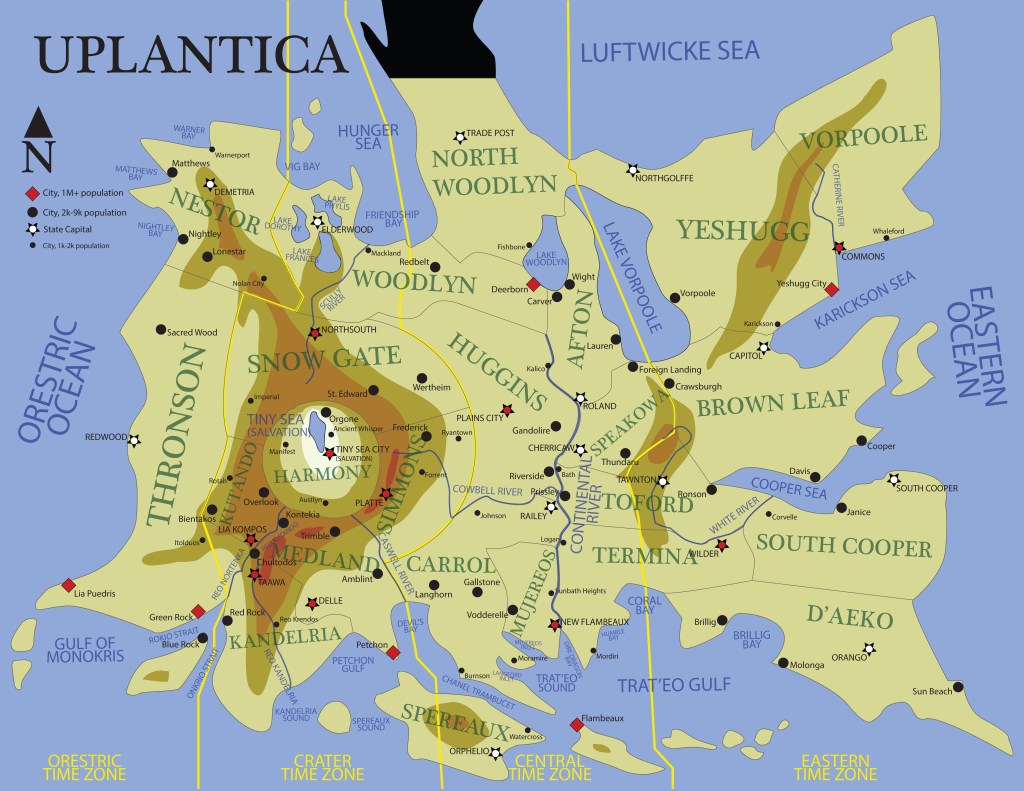
The United States of Uplantica (USU) is a young nation in 1928. It has existed officially since the Uplantic Pact of 1902, in which leaders of the 18 nation states comprising most of the civilized continent formed a “union to better serve themselves and their allies”. Following the end of the Northern War (fought 1887-1894 between Trevens, Speakowans, and Northmen tribes), the nation states of Uplantica moved forward with an ambitious continental trade and peace agreement, brokered by a committee led by Dr. Jean Morsineau, a Spereaux statesman and professor, Annette Tremonte, a wealthy Treven lumber and paper industrialist, Erik Vorpoole, an elder Northmen military leader (his mother was Northern, his father was Treven), and Br. Niko Awaantus, an Itoldun priest of the Harmonyc Brotherhood. After over a decade of grueling but gradually successful negotiation, the committee’s work led to the founding of the USU in 1902, when leaders of 18 nation states met to draw up official borders, agree on a national code of laws, and draft the Uplantic Declaration of Unity. Since 1902, five more states bordering the Eastern Ocean have joined the union (the last of which being D’Aeko in 1915). Today, the 23 states of the USU span the entirety of the continent, united under one flag for the first time in history.
The Arkwomb Legend
The true history of humanity’s beginnings on Uplantica are murky at best. It is clear from the landscape that the continent was devastated by a large celestial object sometime around 2,000 years ago. It is unknown how our species survived that impact. The Harmonyc Brotherhood’s version of events is the most widespread and accepted explanation of humanity’s history, although most modern scholars and scientists hold it in serious doubt. According to the HB, humanity thrived on the continent for millennia before the impact event and achieved advanced technologies. Much like in more recent centuries, the various peoples of the various lands spent much of their histories warring with another. But when astronomers discovered the imminent meteor impact that would surely wipe out life on the planet, the nations that had spent most of their histories at odds with one another took on an unprecedented collaborative effort to save themselves and each other. With just months before certain doom, the united peoples built underground cities that housed humanity while the natural world aboveground recovered from near total destruction. These sprawling underground metropolises are known as Arkwombs. According to the legend, people spent a century living in these elaborate subterranean cities before emerging to reclaim the lands on the surface. Each race built its own vast arkwomb according to plans developed by humankind’s greatest thinkers coming together for the first time. The plans required diverse designs and building techniques from different cultures, as well as the sharing of resources that were previously the objects of seemingly endless conflict stretching back to the very roots of time. Without the cooperation of historically clashing peoples, this ambitious undertaking could never have been possible, both in its conception and its application. The modern Uplantic calendar begins at the year the Treven people emerged into the overworld and began their search for a new promised land in the scorched earth of the impact crater. It’s unclear why the united brotherhood of man that saved humanity didn’t persevere upon emergence from the Arkwombs, as the continent has once again seen constant violent conflict until very recently. Still, the Arkwomb Legend is a uniting cultural touchstone in modern Uplantica, illustrating the spirit of togetherness that makes the USU possible.
A Brief Overview of The Uplantic Continent’s History since Emergence
The Harmonyc Brotherhood spread outward from Harmony, proselytizing and generally subjugating other cultures for centuries after Emergence. From ~100 AE, the Treven Crusaders spread racial and religious intolerance across Uplantica, and also paved the way for the future of the USU by establishing travel routes between the different cultures of the continent.
After roughly 450 years of mostly unrivaled dominance, the first of several uprisings against the Trevens took place in 553 in the mining village of Tulduun, when the family and associates of the deposed leader of the village led a revolt. The fighting stretched on for a month before the Trevens overwhelmed the rebels. However, word of the nearly successful revolt spread, and Itolduns eventually allied with Spereaux to start the Great Uplantic War in 711 by attacking crusader leadership in Petchon. This rebellion, although it had been gathering strategic momentum through clandestine meetings, payoffs, silent assassinations and other such political intrigue in the backrooms of pubs and dark alleys of Treven occupied territories since at least the 6th century, was ushered into full force by the Cherrican Exodus of 704-707, when a group of ~1400 Itolduns escaped from the mines of Kutando and journeyed across the continent to form the new nation of Speakowa with a group of Northmen. This great success set a new precedent and led to more and more numerous small uprisings.
Eventually in 711, a formal declaration of war was made by the United Continental Army (UCA), an official coalition of diverse forces united against Treven imperialism. The war raged on for over 600 years until a truce was called in 1342 in Forrent, Simmons. However, by this time, the original ideals of the UCA (religious and economic freedom) had transformed into a blind hatred of the enemy among most of the populace. Centuries of struggle against a dehumanizing force muted the vibrancy of cultures as they defended themselves. Over time, the lines between tradition, autonomy, and thinking like the enemy to defeat them blurred into a new culture altogether. Thus, the extreme zealous passion and fanatic militaristic unity of the Harmonyc Brotherhood overwhelmed the rebel cultures over time through assimilation rather than force. Despite being considered today to have won the war, the UCA ironically lost much of the cultural autonomy they were fighting for. War and intolerance became the roots of culture itself, and the descendants of those brave rebels who began the Great War became a backwards parody of freedom fighters, reactionary hate mongers, often indistinguishable in deed from their original oppressors. By the end of the war, most of Uplantica followed the teachings of Edward Lilywhite, while non-Treven regions retained very little of their original belief systems, except as aesthetic flavoring of the presentation of the HB tradition. Today, the HB still holds a huge amount of power. Although most Uplanticans consider themselves followers of the HB, most are not devoutly religious, and other religious traditions have gained some ground in the centuries since the Great War ended, with a fairly large upsurge in the last ~50 years, especially after the formation of the USU and the rise of a more open-minded secular Uplantic culture.
While the USU is a “union of equality and justice” on paper, the power structures and prejudices of the Great War era play a huge part in the politics of today. There is a still a large rift of distrust between the Trevens and other races, but Treven power and fortune puts them at the head of the table politically. Tiny Sea City is the sprawling metropolitan center of Uplantica, considered by most (especially Trevens and the HB) to be the unofficial capital.
Four times each year, just before the solstices and equinoxes, the Uplantic Assembly meets in a different capital city. The meeting place is chosen by relevance to the events of the previous quarter. Sometimes meetings of the Assembly are called throughout the year to address national issues that arise. The Assembly meets behind closed doors for up to two weeks, and then a vote is held on issues that require a decision. Each state sends a number of representatives (3-10 representatives, depending on the population of the area) to stand for the wants and needs of their state at the Assembly. Elections are held every two years, and a representative may not hold more than three terms in his or her lifetime. When necessary, the Assembly appoints a Task Force to oversee and enact certain rulings. Despite term limits and the lack of a central national capital, corruption is still widely suspected to be rife within the Uplantic government. Many of the Great War era’s powerful families still maintain inordinate influence, often holding Assembly positions themselves. Cultural and racial divides are still quite apparent in the Assembly, and while the nation is currently at peace (there have been no official military actions in Uplantica since 1894), the scars of the Great War, the Northern War and the various skirmishes across the centuries after Emergence are still visible.
The USU borders only one other nation, Murrg, a sparsely populated arctic continent to the north. Murrg has no central government. It is made up of small tribal village states. Murrg is mostly peaceful, with occasional tribal disputes. Murrgish people are almost entirely albino, and similar to the Northmen in build, mostly large and muscular, although quite a bit more hairy. The people of Murrg do not enjoy the relative modern comforts of life in northern Uplantica. The climate is freezing and the people are hearty. While the general population of modern, civilized Uplantica view Northmen as simple, brutish country folk, their view of Murrg tribes is more along the lines of terrifying feral savagery. The Murrgish trade sparingly with Northmen, but mostly keep to themselves. Murrg remains mostly untouched by Uplantic popular culture, despite Uplantic culture’s ready availability in northern trading towns. Murrg is home to extreme flora and fauna, including bear/cat-like creatures that often grow to be the size of city buses. Due to the dangerous, exotic wildlife and the unrelenting winter weather, Murrg is considered uninhabitable by all but the most hearty and skilled survivors.
 Uplantic Sports Today